
Guide: NOₓ monitoring requirements for U.S. – flagged ships operating in ECA zones and subject to the monitoring provisions of 40 CFR §1042.110(d)
This document presents Danfoss IXA’s current understanding of how to comply with the NOx monitoring requirements of 40 CFR §1042.110(d).
The interpretation is based on Danfoss IXA’s review of the regulation and discussions with the U.S.
Environmental Protection Agency (EPA). However, it should be regarded as preliminary guidance only and is
subject to final EPA confirmation. This document does not constitute an official EPA interpretation or
regulatory approval.
In the following table the exact EPA regulation text is given in the first column; column two presents the interpretation by Danfoss IXA of how this may be implemented on the vessel. The third column describes in which way the NOx analyzer “MES 1001 MARPOL” can support the implementation.
| 40 CFR §1042.110(d). | Danfoss IXA interpretation | MES 1001 MARPOL |
| For Category 3 engines equipped with on-off NOX controls (as allowed by §1042.115(g)), you must also equip your engine to continuously monitor NOX concentrations in the exhaust. See § 1042.650 to determine if this requirement applies for a given Category 1 or Category 2 engine. | Install continuous emission NOx monitoring. | MES 1001 MARPOL is suitable as the NOx measurement device. |
| For measurement technologies involving discrete sampling events, measurements are considered continuous if they repeat at least once every 60 seconds; we may approve a longer sampling period if it is necessary or appropriate for sufficiently accurate measurements. | Sample data at least every 60 seconds. | MES 1001 MARPOL provides a 1-second update rate, and stores values every 30 seconds. Response time (T90) = 10 s |
| Describe your system for onboard NOX measurements in your application for certification. | Describe NOx measurement device, including details of service, maintenance and calibration schedules. | Danfoss IXA can provide an exemplary Chapter to be amended to onboard monitoring manual of an SCR/EGR. |
| Use good engineering judgment to alert operators if measured NOX concentrations indicate malfunctioning emission controls. | Implement a logic (e.g. in the ECS) that evaluates the measured NOx concentration and sends alarm signal to the AMS if a threshold limit is exceeded. The threshold will be engine specific and may vary with engine load. | |
| Record any such operation in nonvolatile computer memory. | Recommended recorded parameters: • Date and time • GPS position • ECA in/out flag • SCR/EGR operational status • CEMS operational status • Raw Measured NOx concentrations in ppm • NOx Threshold limit in ppm engine load • NOx exceedance alarm (on/off) | MES 1001 MARPOL transmits measured NOx concentrations via analog output or ethernet. The analyzer stores measured NOx concentrations in its own read only, non-volatile memory for at least 18 months. GPS input is accepted in which case GPS position and timestamp is stored concurrently. However, for load-dependent threshold limits, it is recommended to record additional data external of the analyzer. |
| You are not required to monitor NOX concentrations during operation for which the emission controls may be disabled under § 1042.115(g). | The NOx monitoring may be turned off when the emission control is legally disabled. | MES 1001 MARPOL can be set in standby by digital signal, saving lamp lifetime and reducing maintenance. |
| For the purpose of this paragraph (d), “malfunctioning emission controls” means any condition in which the measured NOX concentration exceeds the highest value expected when the engine is in compliance with the installed engine standard of §1042.104(g). | Expected values refer to the limits given in 1042.104(a). (Same as in as MARPOL Annex VI, regulation 13). TIER III: 3.4 g/kWh (<130 rpm) 1042.104(g): On-board measurement allowance of 10% exceedance (same as NTC 2008, 6.3.11.1). | |
| Use good engineering judgment to determine these expected values during production-line testing of the engine using linear interpolation between test points and accounting for the degree to which the cycle-weighted emissions of the engine are below the standard. You may also use additional intermediate test points measured during the production-line test. | Load dependent threshold NOx values shall be derived from the production-line engine test and added to technical file. In below example a 10 % exceedance allowance is added to the expected NOx concentration.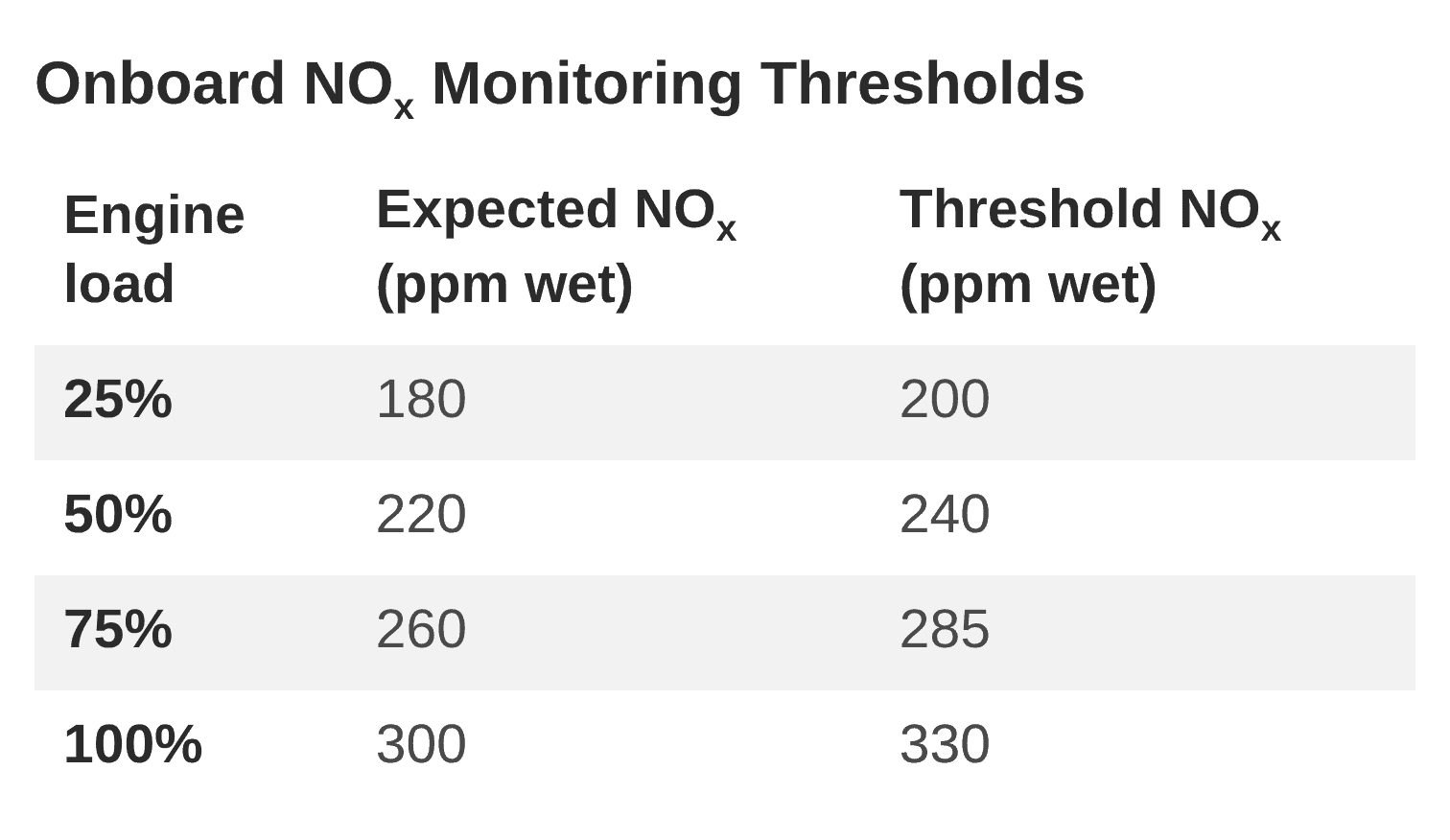 Between the discrete load points the thresholds are found by linear interpolation. The threshold value should be on the same basis (wet/dry) as the approved CEMS used onboard. | MES 1001 MARPOL measures NOx concentration in ppm on wet basis. |
| Note that the provisions of paragraph (a) of this section also apply for SCR systems covered by this paragraph (d). For engines subject to both the provisions of paragraph (a) of this section and this paragraph (d), use good engineering judgment to integrate diagnostic features to comply with both paragraphs. For example, engines may use on-off NOX controls to disable certain emission control functions only if the diagnostic system indicates that the monitoring described in this paragraph (d) is active. | Paragraph (a) prescribes a diagnostic system that monitors and alerts the operator in case of inadequate reductant quality. 1042.660(b) In case of any NOx exceedance alarm an incident, report must be created and submitted within 30 days: The report should include Time, GPS position, Duration of exceedance Cause of exceedance, and Corrective actions. 1042.660(d): The vessel owner must annually review the records and submit a report to EPA certifying compliance during the preceding year or listing all incidences of noncompliance. |